Saturday, February 14, 2015

Arizona Property Management & Investments
Call For a Free Property Management Quote:
 (888) 777 6664
A+ rating with BBB/ Honor Roll List with ADRE
 

 Foreclosures hit a 20-month high both in Phoenix and Arizona as a whole in January.


Senior Reporter- Phoenix Business Journal
2015
Foreclosures hit a 20-month high both in Phoenix and Arizona as a whole in January.
Foreclosures jumped more than 100 percent in January compared to December both in Phoenix and statewide, according to new numbers today from RealtyTrac.
Foreclosure activity both locally and statewide are at 20-month highs as banks step up their repossessions, auctions and filing of default notices.
Phoenix saw a 45 percent increase in January foreclosures compared a year earlier, according to the real estate research firm.
Foreclosure auctions in Arizona were up 37 percent in January, also a 20-month high. Bank repossessions are up 61 percent, according to RealtyTrac.
Those same repossessions are up 58 percent in Phoenix.
There were more than 2,300 homes and condos in the foreclosure process last month. That is up 104 percent from December.
Statewide that increase is 109 percent from January 2014.
The jump in foreclosures comes as the Phoenix housing market tries to shake off a slow 2014 where low demand for homes and tough mortgage qualifications stymied sales.
Foreclosure activity was also up in states such as Ohio, New Jersey, Maryland and California and metropolitan areas such as St. Louis, Los Angeles and San Francisco.
The worst cities for foreclosures include Atlantic City, Las Vegas and eight Florida markets including Tampa, Orlando, Miami and Jacksonville.
"The year-over-year increase in REOs in January was the first annual increase nationwide following 25 consecutive months of declines, getting the foreclosure spring cleaning we anticipated in our last foreclosure report off to a quick start in 2015," said Daren Blomquist, vice president at RealtyTrac. "Meanwhile, the number of future foreclosure auctions scheduled in January continued to increase in many states, foreshadowing more foreclosure spring cleaning to come in the next several months in those states."
Mike Sunnucks writes about residential and commercial real estate, government, law, sports business and workplace issues.

Housing ended 2014 on slow note; Phoenix home starts down 15 percent

Senior Reporter- Phoenix Business Journal
2015
Housing starts ended 2014 down 15 percent across Phoenix while new home sales were off 10 percent and existing sales fell 8 percent as the local residential market slogs into 2015.
RL Brown Housing Reports says 2014 fell short in terms of volume. The regional housing market is challenged by demand stunted by slow population growth, tougher mortgage standards and plenty of borrowers preferring to be or stuck in rentals because of poor credit and past foreclosures.
The average price of a new home last year in the Valley was $351,196, up 1.5 percent, according to RL Brown.
The average price of an existing home was $247,825, up 1 percent. But there are plenty of real estate analysts and agents who note the overall price gains are spurred more by some high-end home sales than price gains across segments.
Another local real estate expert, Jim Belfiore at Belfiore Real Estate Consulting, also expects some housing challenges to persist in at least the first half of this year. Belfiore notes the slip in demand challenges and can create oversupply issues for home builders.
Belfiore does note home builders are seeing some indications that demand could improve this year.
That could be especially true with new subdivisions geared toward seniors in so-called "active adult communities."
_______________________________________________________________________

Rents dip in Phoenix even as more units hit market

Senior Reporter- Phoenix Business Journal
Dec 31, 2014, 12:12pm MST

Rents dip in Phoenix even as more units hit market.
Apartment rents have dropped in the Phoenix metro area even as more new units are entering the market. Still, the RealtyTrac real estate research firm said it's a better deal to buy a house under current conditions than it is to rent an apartment.
That's if a borrower can qualify for a mortgage.
Three-bedroom apartments rented on average for $1,338 per month in Phoenix during this fiscal year, according to RealtyTrac and the U.S. Department of Housing and Urban Development. That is down 5 percent from $1,410 last year.
Rents also declined in Dallas, Las Vegas, Houston, Tucson and Los Angeles. Texas and Southern California — like Phoenix — have seen plenty of new apartment developments. There are more units in the construction pipeline and planning stages and numerous sales this year of older complexes.
Conversely, apartment rental prices increased in markets such as Chicago, Denver and Seattle.
RealtyTrac estimates it takes 33 percent of the median income in Phoenix to rent a three-bedroom apartment compared to 27 percent to afford the Valley's median home price ($188,040). That's after all of the tax advantages are factor into the mix. Still, many borrowers cannot qualify for home loans because of poor credit, previous foreclosures and tighter lending standards.
Median home prices increased 4 percent in Phoenix this year, according to the real estate data company. That is not as strong as home value improvements in California, Texas and Florida.

Phoenix homes among most overvalued in the country

Dec 29, 2014, 6:05am MST Updated: Dec 29, 2014, 7:27am MST

Fitch Ratings says Phoenix-area homes are some of the most overvalued in the country.

Digital Producer- Phoenix Business Journal
If you've thought home prices in Phoenix seem a bit high, you're not alone.
In a new report, bond-rating agency Fitch Ratings says Phoenix-area homes are some of the most overvalued in the country, reports The Arizona Republic. The fifth most overvalued, in fact -- more than pricey California markets Los Angeles and San Francisco.
Metro Phoenix homes are roughly 16 percent overvalued, according to Fitch. The agency pegs Arizona as among the six priciest states.
Statewide, Arizona home prices are 10 to 15 percent overvalued, according to Fitch. That puts it in the same vein as California, Hawaii, Idaho, Nevada and Texas.
Phoenix housing was undervalued in 2011, according to the rating agency. The market was sustainably valued in 2012 and 10 to 15 percent overvalued in 2013.
Besides Phoenix, the rest of Fitch's top 10 overvalued cities are in California, Texas or Florida, with hipster hub Austin ranked at the top. Fitch estimates homes in the Texas capital are 20 percent overvalued, followed by energy boomtown Houston, whose homes are overvalued by 19 percent, according to Fitch.

The world may not be flat, but Phoenix's housing market is

Dec 16, 2014, 1:53pm MST Updated: Dec 16, 2014, 2:07pm MST
The Phoenix housing market will end the year on a flat note.

Digital Producer- Phoenix Business Journal
This year will go down as a generally flat one for the greater Phoenix housing market.
That's according to the latest report from Arizona State University real-estate guru Michael Orr, who noted that demand remains lower than a year ago.
Sales of single-family homes fell 5 percent from October 2013 to October 2014, with activity among first-time home buyers particularly low.
See Also
The report cites the usual culprits of potential buyers carrying tarnished credit histories from the recession and the fact that 20-somethings continue to forgo home purchases.
"We've seen very little change in the greater Phoenix housing market for the last year, and stability is the order of the day," said Orr.
Coincidentally, these are the same reasons the rental market is strong, according to the report.
Rents have risen 3.7 percent during the past year and likely will continue to climb next year.
Despite the challenges of the market during the past year, the median home price still rose 4 percent from October 2013 to October 2014, rising from $200,000 to $208,000.
Also, Orr noted the market is seeing a small bump in investor interest and new-home sales.
The percentage of residential properties bought by investors hit 15.5 percent, the highest level since May, but still well below last year's levels, according to Orr's report.
"Investors and out-of-state buyers are showing a small recovery in buying interest, but to get our market back to what we would consider normal will still require a major increase in demand from local first-time home buyers," Orr said.
New homes are faring better of late, with their share of sales up to 14 percent. That's the same level as it was in October 2013.


Arizona Property Management & Investments
Call For a Free Property Management Quote:
 (888) 777 6664
Saturday, January 10, 2015

The road to American serfdom via the housing market: The trend towards renter households will continue deep into 2015.

 (877) 707-7071


By: DrHousingBubble

If you bought or rented in 2014 a larger portion of your income went to housing.  Rents and housing values are quickly outpacing any pathetic gains to be had with wages.  With the stock market at a peak, talking heads are surprised when the public is still largely negative on the economy.  Can it be that many younger adults are living at home or wages are stagnant?  It can also be that our housing market is still largely operated as some feudal operation.  Many lucrative deals were done with big banks and generous offers circumventing accounting rules.  This works because many perceive they are temporarily embarrassed Trumps, only one flip away from being a millionaire.  Why punish financial crimes when you will likely need those laws to protect your gains once you join the club?  The radio talk shows are all trying to convince people to over leverage and buy a home because you know, this time is the last time ever to buy.  Yet home sales are pathetic because people don’t have the wages to support current prices.  So sales drop and many sellers pull properties off the market.  You want to play, you have to pay today.  Rents are also rising and this is where a large portion of household growth has occurred.  2015 will continue to see housing consume a large portion of income and will lead many into a new modern day serfdom.

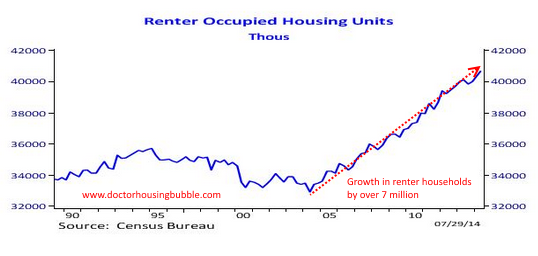
The gain of 7 million rental households
Over the last decade we have added 7 million renting households.  Is this because of population growth?  No.  This trend was driven because of the boom and bust in the housing market.  Investors crowded out regular home buyers in buying single family homes and now, we have millions of new renters out in the market.  Many of these people are folks who lost their homes via foreclosure.
Learn About Credit Card Balances & Credit.
BetterMoneyHabits.com
 
Take a look at the obvious jump in renters:
renter-occupied
For better or worse, homeownership is a path to building equity.  It is a forced saving account for many.  Most Americans don’t even benefit from the stock market peaking because nearly half of the country doesn’t even own stocks.  And many own only a small amount.  Most Americans derive their net worth from their primary residence.  With fewer buying and more renting, I doubt that on a full scale people are suddenly buying stocks for the long-term.  But it is also the case that many are simply renting because that is all they can afford.  Many young Americans have so much debt that this is all they can pay.  Think of places like San Francisco where jobs pay well but rents are simply out of this world and home prices are nutty.
Rents more stable versus wild housing prices
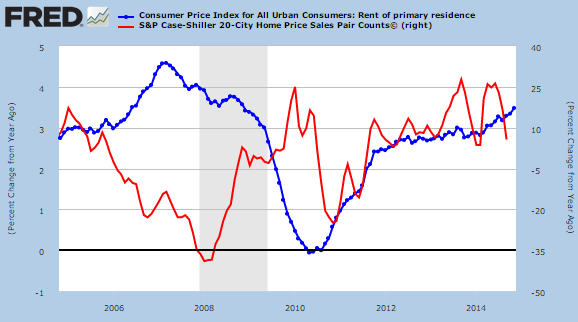
Thanks to low rates, generous tax structures, and the American Dream marketing machine home values are operating in a casino like environment.  This wasn’t the case in previous generation but take a look at fluctuations in rents versus home prices:
rents and home prices
A crazy year for rents is when rents go up over 4 percent year-over-year.  For home values we routinely had year-over-year gains of 25 percent in the last 20 years (including the latest boom in 2013).  Rents are driven by net income of local families.  No funny leverage here.  But with buying homes, you have investors chasing yields, or loans that allow tiny down payments for buyers but then tack on a massive 30 year mortgage with a monthly nut that seems reasonable but only because of a low interest rate.  Some of these people have no retirement account yet take on a $600,000 or $800,000 mortgage without batting an eye.  So what we find is this psychological shift where some that want to buy are convinced that they need to start at the bottom of the ladder and pay an enormous price tag just to get in.  To move out of serfdom, you have to embrace the cult of Mega Debt.
Young adults more likely to stay close to home – and rent
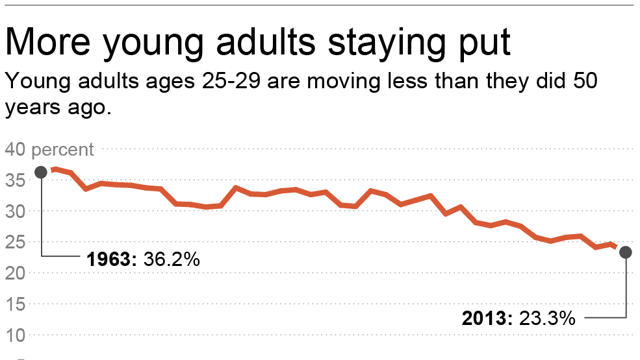
Young adults are facing the biggest impact of the housing crunch.  Many are living at home because they can’t even afford current rents.  Those that do venture out, will likely rent as their first step.  A recent survey found that many young adults are planning on staying local.  Say you live with your baby boomer parents in Pasadena or San Francisco.  You want to buy like they did but good luck.  So many have their network within said community and will likely rent (or live with mom and dad deep into their 30s and 40s):
rentals young adults
I found this data interesting.  People are simply moving less from their home area.  So this will create more demand for rentals in these markets.  In California, we have 2.3 million adults living at home.  Pent up demand?  Unlikely.  The main reason they are at home is because of financial constraints.  These are people that can’t even afford a rental.  I’m sure this trend is occurring in other higher priced metro areas as well.
Rental income soaring for investors
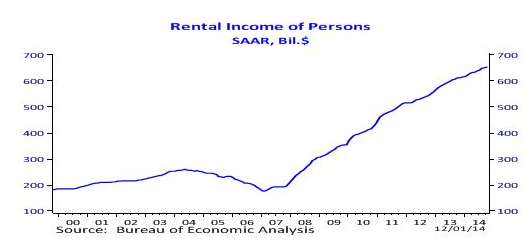
Rental income has soared since the bust happened.  The biggest winners?  Those who bought properties to become the new feudal landlords.  You can see by the below chart that there was a larger concerted effort to consolidate rental income beyond the mom and pop buyers of former years:
rental income
Serfdom is also occurring to many households buying.  They are leveraging every penny into their mortgage payment.  Think you own your place?  Try missing a few payments and become part of the 7 million completed foreclosures since the crisis hit.  2014 simply saw more net income going into housing.  Is this good?  Not really since housing is a dud for the economy unless we have new construction being built but that is not happening on a large scale.  2015 will likely see this continuation of serfdom via renting or buying but at least you might save a few bucks with lower oil!  The road to serfdom apparently runs through housing.

Flip or Hold: Best Real Estate Moves for 2015

 (877) 707-7071


Flip or Hold: Best Real Estate Moves for 2015

Whether it makes sense to flip or hold property depends entirely on your region.

Closeup of a man calculating payments for a home.
There is plenty of positive news for real estate investors to look forward to in 2015.


By + More
Wild fluctuations in the nation’s real estate cycle have taken investors on a roller coaster ride since the early part of this century. From the first decade, marked by overheated home prices in many of the nation’s most popular metropolitan areas, to the post-Great Recession era sending home values into a free fall, investors have had to adjust and adapt their investment strategies to market conditions.

So, going forward, which are the best strategies to pursue for real estate investors next year?
The big picture for 2015. Looking at the nation’s housing and economic indicators, there is plenty of positive news to justify continued investor optimism in 2015. Home sales – both existing and new – are projected to increase next year, which is welcome news for fix-and-flip investors.

At the 2014 Realtors Conference & Expo, Lawrence Yun, chief economist for the National Association of Realtors, or NAR, predicted a rebound for existing home sales for the next two years, and he projects the national median existing-home price will rise at a moderate 4 percent in each of those years. On the new home front, David Crowe, chief economist for the National Association of Home Builders, forecasted in an Oct. 31, 2014 National Association of Home Builders webinar that multi-family housing starts were projected to increase 15 percent in the rest of 2014 and hold steady in 2015.

“Multi-family housing starts have rebounded back to normal since the downturn, mostly due to the strong demand for renting,” says NAR’s Yun, who also notes that renter households have increased by 4 million since 2010, while homeowner households have decreased by 1 million.
Two major concerns remain: tight lending standards, which continue to keep people who could otherwise afford to buy a home from qualifying for a loan to finance the purchase, and interest rates, which are expected to hit at least 5 percent by year-end.

Looking at the numbers. Daren Blomquist, vice president at RealtyTrac, says he believes 2015 is going to be a better year for buy-and-hold investors than for flippers – with the caveat that real estate values vary from area to area and property to property, so investment strategies will have to adjust accordingly.

According to RealtyTrac’s numbers, the volume of properties being flipped declined dramatically, down from their most recent peak of 8.8 percent of all single-family home sales in the second quarter of 2012, to 4 percent of all home sales in the third quarter of this year.
“As home-price appreciation slowed down, the flippers have become less active in this market as well,” Blomquist explains. “The interesting thing is that the volume of flipping is going down, but the average profit on a flip is staying very strong. The gross profit has stayed strong for the past three years in the 30 percent range.”

For buy-and-hold investors, rental properties did well in 2014, although gross rental return was down slightly in the 586 counties surveyed by RealtyTrac, compared to 2013.

“This year was not as good for buying rentals as last year. Last year, we had a 10 percent return because home prices went up, even though rents went up. Returns have slipped a bit because the cost of acquisition went up,” he says.

Still, Blomquist says he believes it is a good time to buy rental properties, because the dynamics of this market are right.

“We will see it flatten out because home prices are starting to flatten out as well. That will allow rents to catch up with home prices, which is good for buy-and-hold investors, but not as good for the flipper,” Blomquist says.

The local perspective. To best-selling real estate author, attorney and longtime investor William Bronchick, 2015 is going to be a good year in the Denver market for owning rental properties, but not as good for flippers.

“It’s great market for rentals, because people still can’t get loans and there’s so many renters. The lending market is tight, so there are more renters, so higher rental rates and lower vacancies make for a great rental market,” Bronchick says. “On other hand, inventory is low, so if you can get your hands on a good motivated property, then you’re good for a flip.”

Working in North Carolina and South Carolina, investor and trainer Larry Goins, says current market conditions in these states are good for both flippers and rental property owners.

“There are deals to be had, but you have to work harder to get them,” Goins says. “I like to buy lower-priced houses and rent them or do lease options or seller financing.”

Specializing in the Atlanta market for decades, Andy Heller, a real estate investor and trainer on these topics, says that since the market crash, a buy-and-hold strategy has made more sense, because investors could buy property very inexpensively.

“Most of the country has settled into a more normal appreciation especially in the last six months or so,” Heller says. “Allowing for the fact that we’re in a time of normal appreciation, what strategy is the best? Both. We don’t have an overheated market and we don’t have a collapsing market.”
In the Greater Phoenix area, supply and demand economics will dictate the right investment strategy in 2015.

“The Greater Phoenix market has been in low supply and low demand for 15 months now,” says Alan Langston, executive director of the Arizona Real Estate Investors Association or AZREIA. “We’re not sure that’s going to change anytime soon. Our market’s been stagnant for a long time, but that doesn’t mean real estate investing has been bad. It’s been different.”

Langston believes investors will continue to be successful, they are whether rehabbing and flipping houses, or holding onto rentals - but they will have to approach the business differently than they used to.

“If you know what you’re doing as a real estate investor, you’re going to adjust what you need to adjust so you do well on your property,” Langston says. “If you’re an informed investor, you’re going to be fine,” he says.

Investor activity varies by investor, region and property types. Auction.com, the largest online real estate marketplace, recently released survey data collected from investors bidding on properties across the country, which confirmed that buying property to hold and rent is currently favored over flipping nationwide. However, investor intent varies considerably between online and offline investors, regions, and property prices.

The study showed that purchasing property to rent is more prevalent in the Midwest and South, whereas there appears to be a higher propensity for flipping in the Northeast. The flip versus rent split is nearly even in the West, with a very slight preference toward renting.

“Real estate investors appear more likely to flip a property in those regions where home values are higher,” says Auction.com Executive Vice President Rick Sharga. “Higher prices can translate to a faster and potentially more significant short-term return on investment. The hold-and-rent strategy seems most popular in markets where home prices are lower, allowing investors to charge a more competitive monthly rental rate and still produce reasonable returns over an extended period of time."
 

Saturday, December 21, 2013

The New Luxury Home Market


The New Luxury Home Market

There’s a nine-month supply of inventory, with more buyers than sellers
by RaeAnne Marsh


With “luxury home” generally defined as a home valued at $500,000 or more, a high percentage of Valley homes would have fallen into that category only a few years ago. Today, however, with the average Valley single-family residence valued at $160,000, “luxury home” encompasses a more select market.

Luxury properties span the Valley in gated and non-gated communities, and include horse properties and golf properties. Number of active days on the market increases with listing price, averaging 133 days for houses in the $500,000 to $600,000 range and 373 days for houses listed at more than $3 million. The average listing in the luxury category is $1.35 million, and Lein notes appreciation is not markedly different from a year ago. Compared to non-luxury properties of $100,000 to $200,000 that appreciated 28 percent per square foot in the past 18 months, luxury home prices increased $3 per square foot.

A little more than 2,400 homes now on the market in the Greater Phoenix area qualify as luxury homes. Selling at an average of 250 per month, this is a 9.4-months’ supply; a year ago, there was an approximately 12.5-month supply. So the glut of homes on the market is definitely receding, and W. P. Carey School of Business reported in October that there were more buyers than sellers in today’s housing market overall.

Foreclosed properties overall is no longer a dominant issue. While America’s housing market is finally starting to really recover from the Great Recession, some areas of the country are fighting back faster than others. New research from the W. P. Carey School of Business at Arizona State University indicates one reason: Different states have dramatically different mortgage laws, and some — like Arizona — make it easier to push through tough times.

“The laws across states use different legal theories as the basis for mortgages, and they balance the rights of creditors and borrowers very differently,” explains Assistant Professor of Real Estate Andra Ghent of the W. P. Carey School of Business. “The variations started early in America’s history, and they’re not really based on economic reasons, but they’re still having a major influence on what’s happening now with the housing market.” Key, she says, is quick resolution of the situation. “For example, if a state requires a longer period before foreclosures can happen, then that generally means the homes deteriorate more as the borrowers realize they’re going to have to leave and stop taking care of the property. This is bad for the neighbors and the property values.”

Arizona is one of the states in which the damage happened relatively quickly, and there’s no longer a big backlog of foreclosures to go through the process. Center for Real Estate Theory and Practice at the W. P. Carey School of Business data shows Phoenix-area home prices have been rising dramatically since last fall.

The market is seeing “some push-back from second-home owners who are concerned about maintaining their second-home lifestyle” in light of possible tax changes, Lein says. Other reasons for selling, he says, fall into the usual categories: death, divorce, relocation and kids growing up. And Lein observes, “There’s a pent-up demand for divorce. People couldn’t afford to get a divorce” when they were underwater on their mortgage.

There is some speculative purchasing, but that is primarily for the foreclosed properties. Other buyers of luxury homes are “move-up individuals,” says Lein, pointing out that even if unemployment is in the high teens, there’s another 80 percent who “are working and susceptible to moving up.” And then there are the multi-nationals who are buying their luxury homes here. Canadians make up a large part of this market; joining them are individuals from Pacific Rim countries, and new to the mix are Chinese. According to Lein, purchases by Chinese are largely trophy properties on the West Coast, but “Paradise Valley has had some sale to what’s reported to be Chinese, who are so new [to Arizona] that, in many cases, they’ve never seen the property” in person.

Lenders today have more to offer this market. Lein notes that two to three years ago, “there was literally nothing available.” But now, he says, “Every week, I’m being approached with new and improved financing programs for luxury-home buyers.”

Phoenix-area home sales dipped in past few months but high-end home sales are climbing!

GLOBAL REAL ESTATE INVESTMENTS 7047 E. Greenway Pkwy #250
Scottsdale, AZ 85308
The Republic | azcentral.com Thu Dec 12, 2013 5:21 PM
 
Homebuyer demand in metro Phoenix has backed off during the past few months, either because of a drop in confidence from the government shutdown or the area’s rising home prices, according to an ASU real-estate analyst.

Sales fell in October while the number of homes listed for sale climbed, according to the latest report from the W.P. Carey School of Business at Arizona State University. The region’s median home price inched up to $200,000 from $199,000 in September.

“Sales will be way down in November and through the holidays, when some people even take their homes off the market until late January,” said Mike Orr, director of W.P. Carey’s Center for Real Estate Theory and Practice. “We also anticipate a much slower rate of price appreciation in 2014 than the furious pace we have witnessed over the last two years.”

In October, 7,045 houses sold in metro Phoenix. That’s about 100 fewer sales than in September. In the spring, home sales were hovering around 9,000 a month.

Home sales to investors as well as those to out-of-state buyers have dropped over the past six months. Investors were behind almost 40 percent of all home sales in July 2012, the peak of those types of purchases. In October, investor purchases accounted for about 23 percent of home sales. Second-home buyers from outside Arizona accounted for 16.4 percent of October’s home sales, down from 20.1 percent a year earlier.

High-end home sales are climbing, which partially accounts for the higher median price. Sales of homes priced above $500,000 are up 34 percent from a year earlier.

Listings are up 40 percent since November 2012, though Orr said the supply of homes for sale still is 15 to 20 percent below what would be considered normal for metro Phoenix.

Currently, about 26,500 homes are for sale in the Valley.